




BC Business Source Details Database Updated: 117,926 Selected Listings
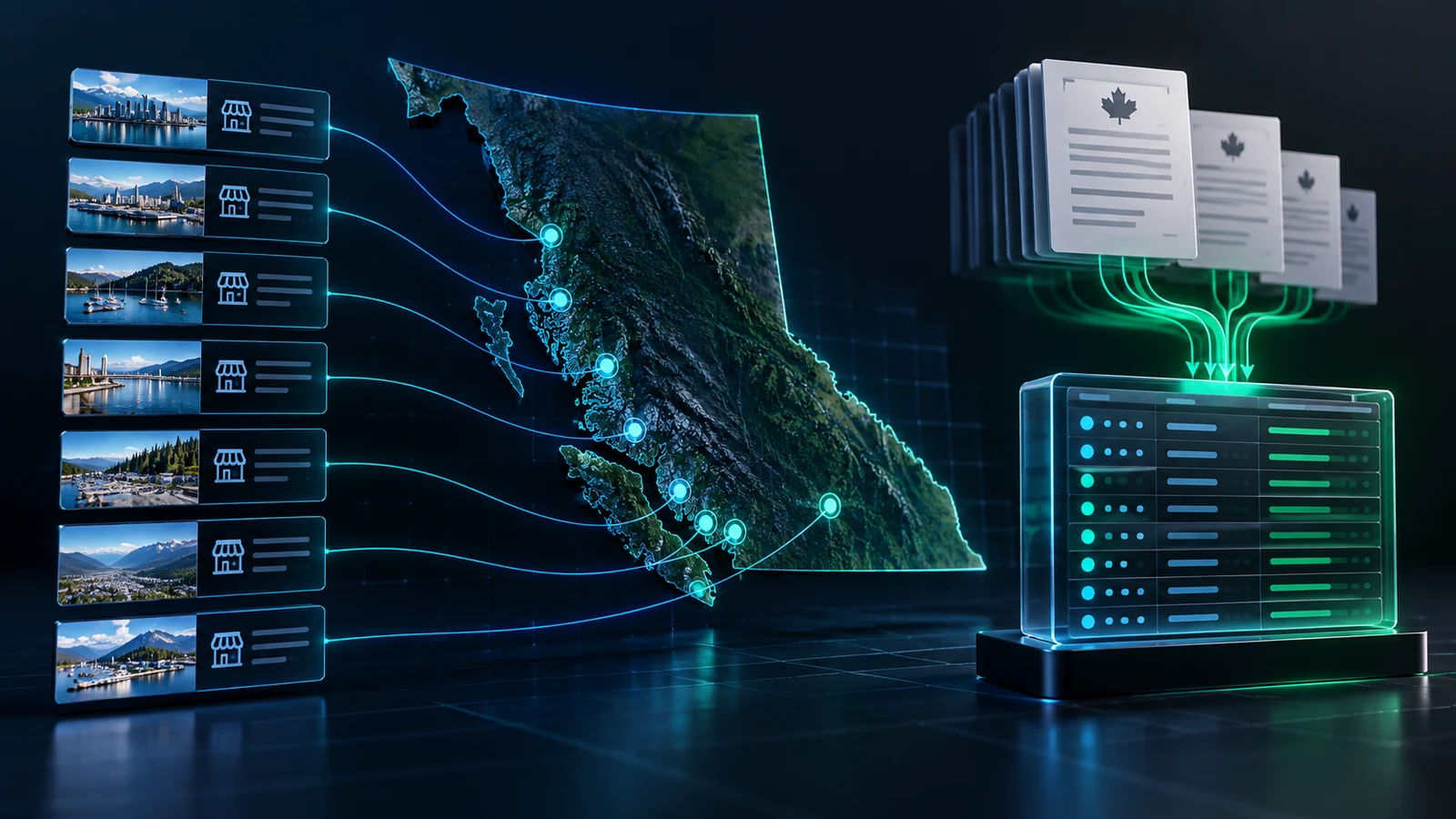
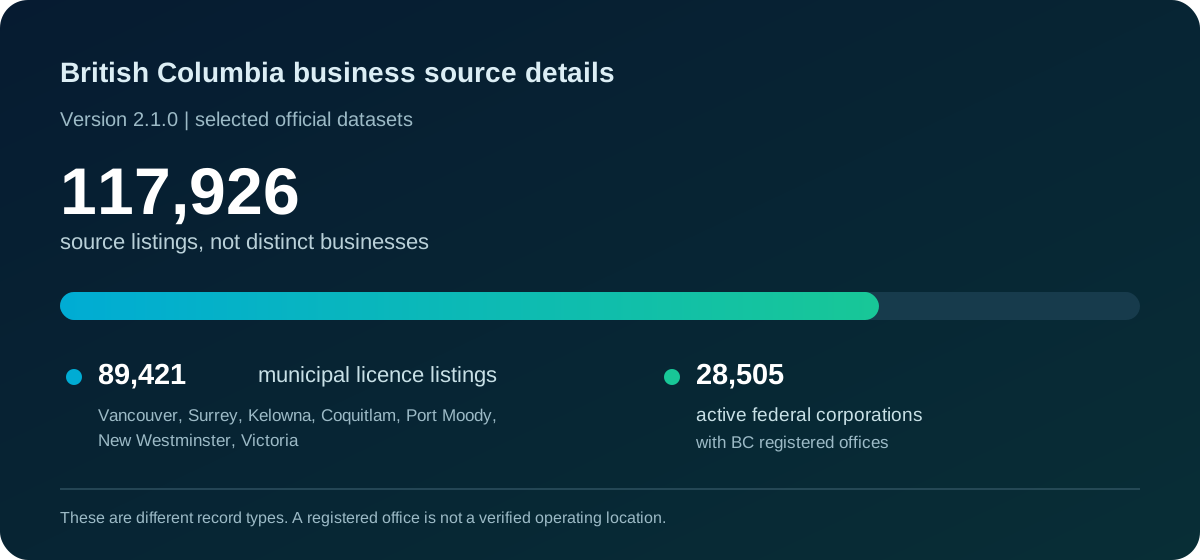
The British Columbia business data release is now at version 2.1.0. It contains 117,926 source listings drawn from selected official open datasets: 89,421 municipal business licence listings and 28,505 active federal business corporations with registered offices in British Columbia. The municipal portion covers Vancouver, Surrey, Kelowna, Coquitlam, Port Moody, New Westminster, and Victoria. The federal portion adds a different record type, with its own definition of location. Every row carries its source type so you can decide which records belong in your project.
The most useful way to read that total is as a count of listings, not a count of distinct businesses. A company may appear in a municipal licence feed and in the federal corporation set. A federal registered office is an administrative address and does not establish that a business serves customers or operates at that site. Likewise, a city licence reflects that city's published licence record, not a province-wide registry entry. If you are building a directory, estimating a market, or comparing places, those distinctions should remain visible in your analysis.
What changed in this release
This release replaces the older customer data with a current, labelled population from the selected sources. The files are organized so that source type, locality, name, status, and available detail can be inspected in a consistent structure. The package provides UTF-8 CSV, JSON, and SQLite, along with a schema, sample, field statistics, and documentation. It is designed to be useful in a spreadsheet, a database, or an application without making you infer where a row came from.
The municipal records represent the seven named city feeds. Those cities publish different fields and make different choices about what can be shown. A street address, phone number, category, website, or date may be present in one feed and absent in another. Some municipalities withhold address details for privacy. We preserve those absences as missing values rather than inventing a value from a nearby field or another source. This matters when you plan a map, an outreach workflow, or a coverage calculation.
The federal set includes active business corporations with a BC registered office in the selected official snapshot. This broadens the release beyond city licences while retaining a clear record label. It does not convert a registered office into a verified trading location. It also does not claim to contain every provincial corporation, every sole proprietorship, or every operating business in British Columbia. Review the record type before combining the two populations or counting organizations.
Choose the detail that fits your work
Usage, Publication, and Master are separate licence options for this version. Usage is intended for internal analysis and includes the core directory fields. Publication adds the available published location, phone, and category detail for customer-facing work under the Publication terms. Master provides the remaining available website, date, and source identifier fields and its broader client handoff rights. The number of source listings is the same across the three tiers; the fields and permitted uses differ.
Each tier includes CSV, JSON, and SQLite. CSV is convenient when you need to inspect rows in a spreadsheet or pass them to an existing import process. JSON is useful when an application or transformation pipeline works with named fields. SQLite gives you a portable relational file for querying, filtering, and joining locally. Use the included schema and documentation to confirm a field's meaning before building a workflow around it, especially when a value is missing for many rows.
The public product page includes a sample and table statistics. The statistics show measured distinct and missing values for the published fields, so you can see where coverage is sparse. A blank value and a null value are both counted as missing in this release. That makes the figures more useful for planning than a field list alone. A field's presence in the schema does not promise that every publisher supplied it for every listing.
Working with the two record types
Start with the question you need to answer. For a city-level licence view, filter to the municipal type and to one of the seven cities. For a registered-office view, use the federal corporation type and understand that its locality means something different. If you combine the types, retain the record label in reports and interfaces. This prevents a registered office count from being presented as a count of storefronts or operating sites.
Be careful with deduplication. Similar names and addresses can indicate a shared organization, a branch, an office service, or unrelated entities. The release does not assert a universal business identity across publishers. You may choose to match records for a specific project, but test the matching rules and keep the original rows available for review. A simple name match can merge separate businesses; an exact address match can group many tenants in one building.
Dates and status also need context. A municipal licence status comes from its city feed, while the federal active status refers to the corporation record. They are not interchangeable indicators of current trade. If your project has a freshness requirement, check the source and release date, then review the publisher's current record where the decision depends on a single business. This is especially useful before you publish a profile, contact an organization, or make a location-specific claim.
Published contact and location fields are best treated as source attributes, not as a guaranteed outreach list. Phone and website coverage varies. An address may be missing, withheld, administrative, or unsuitable for a map pin. Build your workflow to tolerate empty cells and to show users what was actually published. If a missing value is essential, verify it through an appropriate current source rather than filling it by assumption.
Where the boundaries are
This package covers selected municipal licence feeds plus the specified active federal corporations. It is not a complete BC business registry export. Municipalities outside the seven named cities are not represented by the municipal component, and other business forms may fall outside the federal component. The listing total should not be described as all BC businesses, all BC locations, or a count of unique firms. Those phrases would promise coverage that this release cannot support.
Source rights and usage terms are part of the delivered package. Read the included source notice and the Oddity licence that applies to your purchase before using the files, especially for publication or client delivery. The notice travels with each tier's files so attribution stays with the data when the package is moved into a project. The product page explains the scope and licence choices without turning the source notice into a public page attachment.
For most projects, the practical starting point is the sample: inspect the record types, compare which fields are populated, and decide whether your intended geography is covered. Then choose the licence by how the data will be used, not only by its field count. If you need a complete provincial registry population or a different set of municipalities, this selected-source release should be treated as a starting dataset rather than a substitute for that separate requirement.
Version 2.1.0 is available now on the British Columbia business source details product page. The page includes the sample, field statistics, coverage description, and current prices for all three tiers. Existing eligible Master customers can review the current version update offer in their account. Check the page and the delivered documentation for the exact version you are using so your analysis, published figures, and licence rights stay tied to the same release.
Start a useful discussion below. Your contribution will appear after staff review.